Finding the right AI SEO tools has become more important than ever. Traditional SEO still matters, but search is changing as people increasingly rely on AI-powered platforms to discover information, compare products, and make buying decisions. Whether you’re a blogger, business owner, marketer, or agency, choosing the right solution can improve your visibility across both search engines and AI assistants.
This guide compares the best AI SEO tools for 2026, explains how each platform fits different workflows, and highlights where every solution performs best. From enterprise-grade monitoring to content optimization and AI writing, these tools help you stay competitive as AI-driven search continues to evolve.
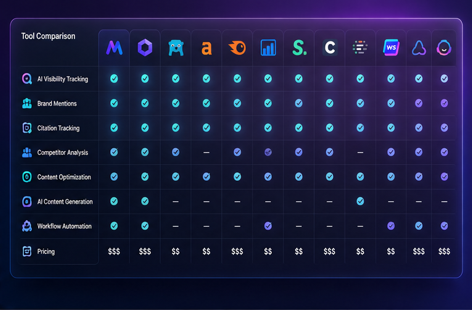
Quick Comparison: Best AI SEO Tools for 2026
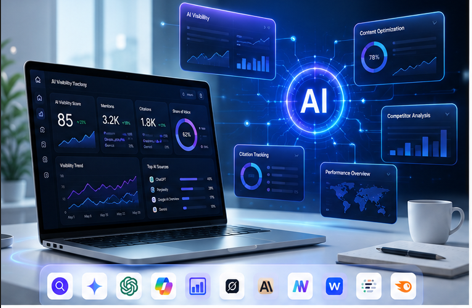
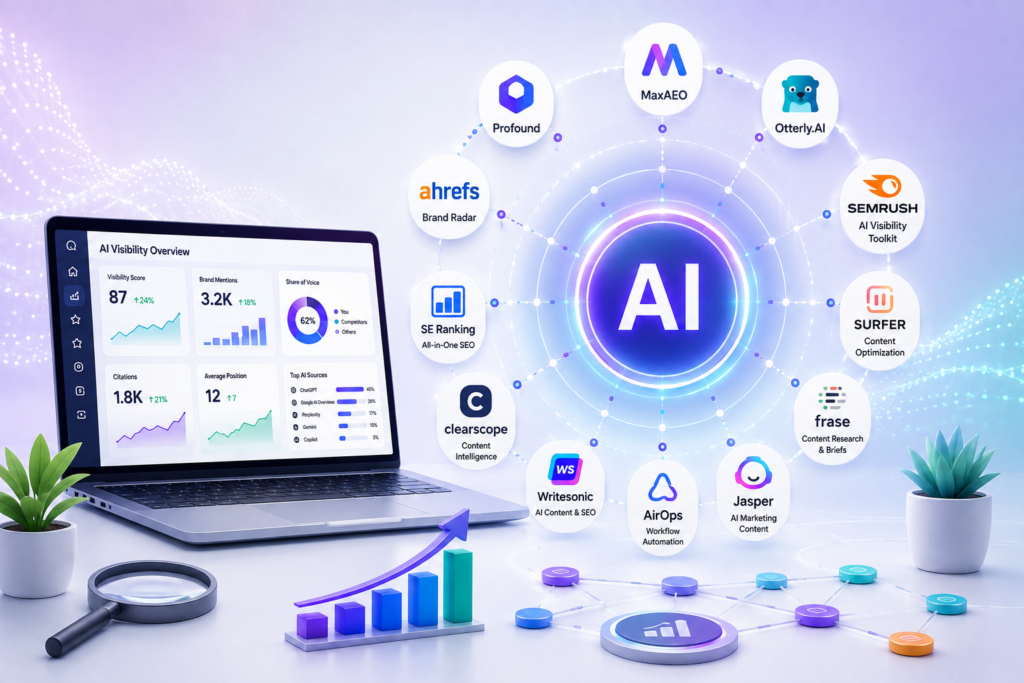
The latest generation of AI SEO tools covers much more than traditional keyword rankings. Platforms such as MaxAEO, Profound, and Otterly.AI focus on AI visibility, helping brands understand how often they appear across AI search platforms and major answer engines like ChatGPT, Gemini, Claude, Perplexity, Copilot, Grok, Google AI Mode, and Google AI Overviews. These platforms emphasize visibility monitoring, citation tracking, brand mentions, sentiment, competitor benchmarking, optimization actions, and AI search analytics, making them valuable for businesses that want to improve their presence in AI-generated answers.
Quick Comparison: Best AI SEO Tools for 2026
| Tool | Best For | AI Visibility | Content Optimization | Enterprise | Starting Price |
| MaxAEO | AI visibility & optimization | ⭐⭐⭐⭐⭐ | ⭐⭐⭐ | ⭐⭐⭐⭐ | $15/mo |
| Profound | Enterprise AI analytics | ⭐⭐⭐⭐⭐ | ⭐⭐ | ⭐⭐⭐⭐⭐ | Custom |
| Otterly.AI | AI search monitoring | ⭐⭐⭐⭐ | ⭐⭐ | ⭐⭐⭐ | $29/mo |
| Ahrefs Brand Radar | SEO + AI visibility | ⭐⭐⭐⭐ | ⭐⭐⭐ | ⭐⭐⭐⭐ | Included with Ahrefs |
| Semrush AI Visibility Toolkit | Enterprise SEO & AI | ⭐⭐⭐⭐ | ⭐⭐⭐ | ⭐⭐⭐⭐⭐ | From $99/mo |
| SE Ranking | All-in-one SEO platform | ⭐⭐⭐ | ⭐⭐⭐⭐ | ⭐⭐⭐ | Custom Plans |
| Surfer SEO | On-page SEO & content | ⭐⭐ | ⭐⭐⭐⭐⭐ | ⭐⭐⭐ | $49/mo |
| Clearscope | Content optimization | ⭐⭐ | ⭐⭐⭐⭐⭐ | ⭐⭐⭐⭐ | $129/mo |
| Frase | AI content briefs & writing | ⭐⭐ | ⭐⭐⭐⭐ | ⭐⭐⭐ | $39/mo |
| Writesonic | AI writing & GEO | ⭐⭐⭐ | ⭐⭐⭐⭐ | ⭐⭐⭐ | $79/mo |
| AirOps | Workflow automation | ⭐⭐⭐ | ⭐⭐⭐⭐ | ⭐⭐⭐⭐⭐ | Custom |
| Jasper | Marketing content creation | ⭐⭐ | ⭐⭐⭐⭐ | ⭐⭐⭐⭐ | $59/mo |
⭐ Editor’s Picks
🏆 Best Overall AI Visibility Tool: MaxAEO
🏢 Best for Enterprise Teams: Profound
📈 Best Traditional SEO + AI: Semrush AI Visibility Toolkit
📝 Best Content Optimization: Surfer SEO
✍️ Best AI Writing Platform: Writesonic
⚙️ Best Workflow Automation: AirOps
💰 Best Budget-Friendly Option: Otterly.AI
At the same time, established SEO platforms continue expanding their capabilities. Ahrefs Brand Radar, Semrush AI Visibility Toolkit, and SE Ranking combine traditional SEO with AI visibility tracking, keyword research, backlink research, technical SEO, search visibility, and reporting. Content-focused platforms such as Surfer SEO, Clearscope, Frase, Writesonic, AirOps, and Jasper support content optimization, content briefs, AI writing, workflow automation, marketing copy, topic research, internal linking, SERP research, topical coverage, content scoring, and AI content operations. Pricing ranges from entry-level plans around $15 to enterprise solutions exceeding $489, allowing solo marketers, brands, agencies, SEO teams, and enterprise teams to choose a platform that matches their goals, workflows, and budget.
How We Evaluated These AI SEO Tools
Choosing the right platform requires more than looking at features on a pricing page. Every tool in this comparison was evaluated based on its ability to improve AI visibility, support AEO, GEO, and LLMO strategies, and provide reliable monitoring, optimization, and reporting. We also considered engine coverage, prompt tracking, citation tracking, sentiment, framing analysis, competitor benchmarking, data exports, recommended actions, workflow integration, content optimization, content brief quality, SERP research, topic research, on-page optimization, and overall usability for different business sizes.
Another important factor was how well each solution fits into existing marketing workflows. Platforms such as Semrush, Ahrefs, and SE Ranking are ideal for organizations that already rely on established SEO ecosystems, while specialized solutions focus entirely on AI search, AI visibility, AI answers, answer engines, brand mentions, optimization guidance, and competitive analysis. We also reviewed pricing transparency, available plans, supported domains, users, prompts, and the overall value each platform delivers for marketers, agencies, startups, and enterprise organizations
MaxAEO
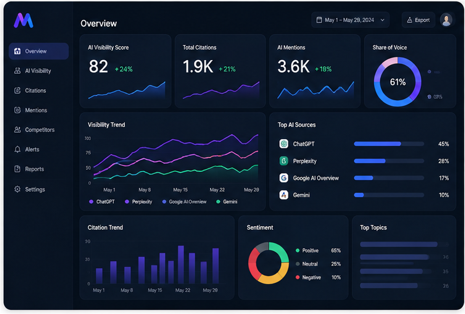
If your goal is to improve visibility in AI-generated search results, MaxAEO is one of the strongest platforms available today. Unlike traditional SEO software that focuses mainly on rankings and backlinks, MaxAEO is built around AI visibility. It continuously monitors how your brand appears across leading AI engines and answer engines, including ChatGPT, Gemini, Perplexity, Claude, Copilot, Grok, Google AI Mode, and Google AI Overviews. Instead of showing only rankings, the platform analyzes brand visibility, brand mentions, citation intelligence, citation tracing, sentiment, competitor benchmarking, AI answers, and overall visibility tracking, giving businesses a much clearer picture of their performance in AI-powered search.
One feature I particularly like is that MaxAEO doesn’t stop at collecting data. It transforms monitoring into actionable optimization by providing practical optimization actions, optimization recommendations, and content-action workflows. You can review prompt monitoring, identify missing citations, discover weak positioning, compare competitors, inspect sources, measure your brand mention rate, and even detect how model changes affect your visibility. The no-code setup, website URL onboarding, daily monitoring, tracking, workflows, and detailed recommendations make it a practical choice for marketers who want to improve AI search performance without building complex reporting systems.
Where MaxAEO Excels
The biggest strength of MaxAEO is its complete monitoring-to-optimization approach. Instead of acting as a simple mention counter, it evaluates how brands are recommended, where they appear in AI answers, and how they perform across the evolving AI search market. Businesses can compare competitors, review sentiment inspection, perform citation tracing, analyze prompts, discover content gaps, identify missing sources, and receive clear optimization actions based on real AI responses rather than assumptions.
From my experience reviewing AI visibility platforms, this workflow feels much more practical than manually testing dozens of prompts every week. Being able to inspect, identify, trace, recommend, and compare visibility across multiple AI engines saves significant time while helping brands build stronger optimization strategies, improve ranking, increase mentions, strengthen brand visibility, and expand their presence across modern answer engines.
Key Features
The platform combines several advanced capabilities into a single dashboard. Core features include multi-engine monitoring, tracking across eight AI answer surfaces, measuring brand mention rate, monitoring ranking, evaluating sentiment, performing competitor benchmarking, enabling detailed citation tracing, tracking sources, supporting continuous daily monitoring, detecting prompt changes and model changes, offering a simple no-code setup, connecting through your website URL, generating optimization recommendations, building automated content-action workflows, improving AI visibility, and simplifying long-term visibility tracking.
Pricing
MaxAEO offers multiple plans designed for businesses of different sizes, including Starter Brand Check, Starter, Brand Check, Growth, Pro, and Enterprise options. Pricing starts at $15, while higher plans such as $119 and $319 include additional features through annual billing or monthly subscriptions. Since pricing and available features change over time, it’s always worth checking the latest plan details before making a decision.
Limitations
Although MaxAEO is one of the most advanced platforms for AI visibility tracking, it is not intended to replace a complete legacy SEO suite. It doesn’t focus on backlink research, technical crawling, traditional rank tracking, keyword database management, or comprehensive keywords analysis like Ahrefs, Semrush, or SE Ranking. For most organizations, the best approach is combining tracking, monitoring, citation intelligence, optimization actions, and AI-focused insights from MaxAEO with a broader SEO platform to build a complete digital marketing strategy.
Profound
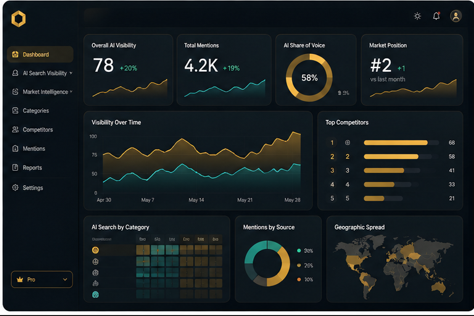
For large organizations that need detailed reporting across multiple markets, Profound stands out as one of the most capable AI visibility platforms. Instead of concentrating only on individual prompts, it provides deep AI search analytics and answer-engine analytics that help businesses understand how their brands perform across modern search experiences. The platform focuses on enterprise reporting, offering advanced competitive benchmarking, competitive intelligence, category-level analysis, share of voice, brand performance, citation analysis, mention analysis, and detailed analytics that support long-term growth. Companies managing several products, regions, or business units can use Profound to organize dashboards, improve reporting, and identify trends across multiple AI search surfaces.
From my experience evaluating enterprise SEO platforms, Profound is designed for organizations that rely heavily on data-driven decisions. Rather than simply showing visibility scores, it helps marketing teams understand competitor movements, brand positioning, and overall market presence. With detailed optimization insights, content insights, AEO programs, and structured enterprise workflows, businesses can make strategic decisions based on reliable AI search data instead of assumptions.
Where Profound Excels
The biggest advantage of Profound is its ability to deliver enterprise-grade reporting. Large brands often need visibility across multiple product lines, regions, and competitor clusters, and this platform provides that level of detail. Features such as AI search visibility, share of voice, competitive intelligence, category-level AI search analysis, executive reporting, internal analytics, and benchmarking make it particularly valuable for organizations with dedicated SEO and marketing departments.
Another area where Profound performs exceptionally well is helping businesses understand the language used in AI search. By analyzing prompt volume, brand complexity, organization performance, and overall AI SEO discussions, teams gain a better understanding of how AI systems interpret their brand. This makes long-term planning much easier than relying only on traditional ranking reports.
Key Features
The platform includes comprehensive AI search visibility tracking, advanced reporting, competitive benchmarking, support for multiple answer engines, detailed citation analysis, mention analysis, customizable dashboards, structured enterprise workflows, actionable content insights, practical optimization insights, dedicated AEO programs, centralized AI visibility management, continuous tracking, and enterprise-level analytics.
Pricing
Unlike many traditional SEO tools, Profound primarily serves enterprise customers through custom pricing. Businesses can request tailored plans based on team size, reporting requirements, and implementation needs. The company regularly updates its pricing page, so reviewing the latest pricing plans, available Enterprise options, and annual billing details before purchasing is recommended.
Limitations
Although Profound offers powerful AI visibility capabilities, it is primarily designed for larger organizations. Smaller businesses or startups looking for affordable multi-engine monitoring, simple workflows, or lower-cost entry plans may find platforms like MaxAEO or Otterly.AI more practical. Companies should evaluate their reporting requirements, available budget, and internal resources before selecting an enterprise-focused platform.
Otterly.AI
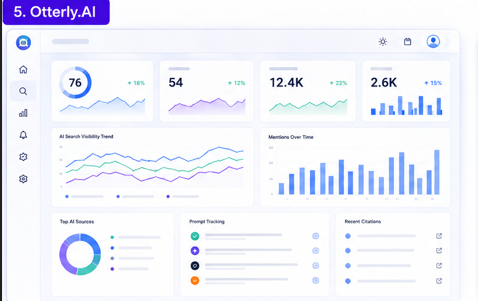
If you’re looking for a lightweight way to monitor your brand across AI-powered search, Otterly.AI offers a straightforward solution. The platform specializes in AI search monitoring, helping marketers track AI visibility, brand mentions, website citations, prompts, and sentiment across popular answer engines such as ChatGPT, Perplexity, and Google AI Overviews. Instead of relying on manual screenshots or repeated prompt testing, users can monitor their brand from a single dashboard while exporting useful reports for clients or internal teams.
What impressed me most is how approachable Otterly.AI feels for smaller businesses. Agencies, startups, and lean SEO teams can quickly define search prompts, monitor citations, review position tracking, perform geo-auditing, export data, and simplify ongoing monitoring workflows without the complexity often found in larger enterprise platforms. While it doesn’t provide the same depth of optimization actions as MaxAEO, it delivers reliable visibility insights for businesses that primarily want to understand how AI platforms reference their brand.
Where Otterly.AI Excels
The greatest strength of Otterly.AI is its simplicity. Businesses can easily track AI visibility, review brand appearance, monitor citations, manage prompts, and generate export data across supported AI engines without building complicated reporting systems. This makes it especially useful for marketers, agencies, startups, and lean SEO teams that need clear visibility into AI-generated search results.
The platform also eliminates much of the repetitive work involved in manual AI testing. Instead of collecting manual screenshots, users receive organized monitoring, practical search monitoring, and structured reports that make it easier to evaluate performance across different answer engines.
Key Features
Core features include AI brand mention tracking, citation tracking, prompt monitoring, geo-auditing, sentiment tracking, position tracking, data export, detailed reporting, and flexible plans including Lite, Standard, Premium, and Enterprise, all designed to improve AI visibility through reliable monitoring.
Pricing
Otterly.AI offers several pricing tiers, including Lite, Standard, Premium, and Enterprise plans. Entry pricing starts around $29, while larger plans reach approximately $489, depending on search prompts, add-ons, usage limits, and selected features. Checking the latest pricing information before subscribing is always recommended.
Limitations
Although Otterly.AI performs well for monitoring and tracking, organizations that require advanced optimization actions, detailed citation gaps analysis, or a complete monitoring-to-action workflow may benefit from pairing it with a platform such as MaxAEO. Businesses with extensive reporting requirements should also consider future prompt limits, additional engine add-ons, and overall scalability.
Ahrefs Brand Radar
For businesses already using the Ahrefs ecosystem, Ahrefs Brand Radar is a practical addition that brings AI visibility into a familiar SEO workflow. While Ahrefs has always been known for keyword research, backlink research, and content research, Brand Radar extends those capabilities by helping marketers understand how their brands appear across AI search and modern LLMs. Instead of replacing traditional SEO, it connects brand visibility, web mentions, discoverability, and competitor data with the metrics SEO professionals already use every day. This makes it easier to understand how AI-generated search results influence your overall digital presence.
One aspect I appreciate is how naturally Brand Radar fits into an existing SEO strategy. Teams don’t need to learn an entirely new platform because the feature integrates with the broader SEO ecosystem. Businesses can continue using keywords, search demand, competitor research, and reporting while gaining additional insight into AI visibility tracking, AI answer engines, and brand authority. For organizations already invested in Ahrefs, this creates a smoother transition into AI-focused optimization.
Where Ahrefs Brand Radar Excels
The biggest advantage of Ahrefs Brand Radar is its ability to combine traditional SEO with emerging AI search insights. Businesses can analyze legacy SEO ecosystem data alongside brand authority, competitor content, discoverability strategy, web mentions, and AI visibility, giving marketing teams a more complete understanding of online performance. Rather than working with separate reporting systems, everything stays connected inside one platform.
It is especially valuable for SEO professionals who already depend on Ahrefs for daily work. Instead of switching between multiple tools, users can combine keyword research, backlink research, content opportunities, search demand, competitor research, visibility layer, tracking, optimization, and reporting within the same workflow.
Key Features
Key capabilities include brand visibility tracking, support for LLMs, monitoring across search and the web, access to competitor data, integrated keyword research, comprehensive backlink research, detailed content research, customizable custom prompts, dedicated Brand Radar functionality, flexible plan availability, optional add-on availability, advanced SEO reporting, seamless integration, and reliable AI visibility insights.
Pricing
Ahrefs Brand Radar is available through Ahrefs plans, although pricing may vary depending on your selected plan, add-on, and region. Because Ahrefs occasionally adjusts its dynamic pricing, it’s best to review the official pricing information before subscribing or upgrading your account.
Limitations
Although Ahrefs Brand Radar adds valuable AI visibility insights, it is not a dedicated GEO platform. Features such as continuous daily AI prompt monitoring, detailed citation tracing, advanced sentiment analysis, and extensive action recommendations are more specialized in platforms like MaxAEO. Businesses focused entirely on AI-generated search visibility may prefer combining Ahrefs with a dedicated AI visibility solution.
Semrush AI Visibility Toolkit
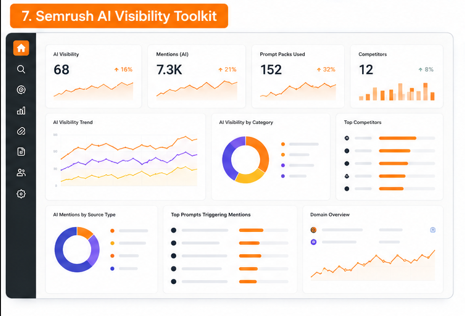
The Semrush AI Visibility Toolkit expands one of the industry’s most established SEO platforms by adding dedicated AI visibility features. Instead of separating AI search from traditional optimization, Semrush connects keyword rankings, competitor domains, market research, SEO reporting, and AI answers into one integrated workflow. This makes it particularly useful for agencies and businesses already relying on the Semrush ecosystem for day-to-day SEO management.
From my experience, one of the strongest advantages of this toolkit is reducing reporting fragmentation. Rather than exporting information from multiple platforms, marketers can review prompt tracking, brand performance, competitor context, visibility tracking, analytics, and reporting inside the same environment. This creates a more efficient workflow for teams managing several websites or clients.
Where the Semrush AI Visibility Toolkit Excels
The toolkit performs best for businesses that already depend on Semrush. It combines cross-layer context, keyword rankings, competitor domains, market research, SEO reporting, AI visibility, prompt tracking, brand presence, and centralized dashboards into one reporting workflow. This helps stakeholders, agencies, and SEO departments make faster decisions without switching between multiple platforms.
Because AI search is evolving rapidly, having both traditional SEO metrics and AI-focused insights together creates a more complete picture of search performance. Businesses can monitor domain visibility, improve optimization strategies, and simplify long-term reporting through a single platform.
Key Features
Important features include AI visibility tracking, domain monitoring, prompt tracking, brand performance, competitor context, integration with the Semrush ecosystem, flexible add-on licenses, support for multiple users, domains, and prompts, detailed reporting, enterprise-ready SEO suite functionality, and ongoing AI visibility analysis.
Pricing
The Semrush AI Visibility Toolkit is available as an add-on with pricing based on selected features. Plans may include options starting around $99 per month, with additional costs such as $60 for extra domains, users, or prompt packs. Since pricing and available features change regularly, checking the official Semrush pricing page before purchasing is recommended.
Limitations
Although the Semrush AI Visibility Toolkit is a powerful extension, it remains an add-on rather than a completely standalone platform. Organizations managing many multiple domains, users, or extensive prompt sets should carefully evaluate the overall effective cost. Businesses requiring highly specialized citation-level action planning or advanced AI search workflows may still benefit from pairing Semrush with a dedicated AI visibility platform.
SE Ranking
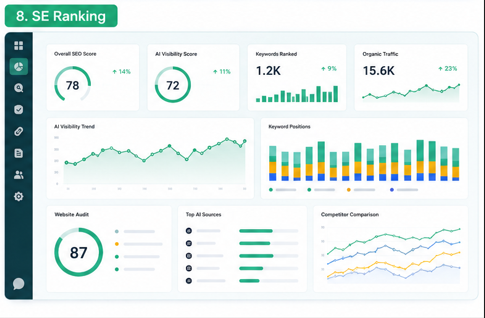
For businesses that want to manage both traditional SEO and AI-driven search from a single platform, SE Ranking offers a balanced solution. While many tools focus on one area, SE Ranking combines AI visibility, AI search tracking, rank tracking, website audit, technical SEO, competitor research, keyword research, content workflows, and content optimization in one dashboard. This approach makes it easier for marketers to monitor organic performance while also understanding how their brand appears in AI-generated search experiences.
After using several SEO platforms over the years, I appreciate how SE Ranking keeps everything organized without becoming overwhelming. Instead of jumping between multiple applications, teams can review SEO analytics, reporting, organic rankings, brand demand, AI answer monitoring, and ongoing tracking from one place. For agencies and growing businesses, this saves time and creates a more efficient optimization workflow.
Where SE Ranking Excels
The biggest advantage of SE Ranking is its all-in-one approach. Businesses can combine operational SEO, traditional SEO, technical checks, competitor research, content optimization, AI visibility tooling, organic rankings, and AI answer presence without maintaining several separate subscriptions. This makes it especially valuable for companies that want a practical platform instead of a collection of disconnected tools.
Because AI search continues to grow alongside traditional search engines, having both performance metrics available in one interface helps marketers make smarter decisions. The platform supports a complete workflow, making it easier to improve search visibility, optimize content, monitor rankings, and generate professional reporting for clients or stakeholders.
Key Features
Core features include AI visibility tracker, AI answer monitoring, traditional rank tracking, website audit, competitor research, keyword research, advanced content tools, on-page SEO, detailed reporting, support for SEO teams, agencies, and continuous monitoring for improved AI visibility.
Pricing
SE Ranking offers flexible plans based on usage, selected features, and billing preferences. Pricing varies depending on the chosen plans, billing term, available AI modules, and access to the AI Visibility Tracker. Since pricing changes over time, reviewing the latest information before purchasing is recommended.
Limitations
Although SE Ranking provides useful AI search visibility features, its AI capabilities are part of a broader SEO suite rather than a dedicated AI platform. Businesses looking for advanced recommendation tracking, executive board-level KPI reporting, or highly focused AI workflows may benefit from pairing SE Ranking with a specialized AI visibility solution.
Surfer SEO
When the goal is publishing content that performs well in search, Surfer SEO remains one of the most trusted platforms available. Instead of focusing primarily on monitoring AI search, Surfer helps writers build stronger pages through AI-assisted content optimization, content production, content briefs, on-page optimization, SERP analysis, topic recommendations, and optimization scoring. It is designed to improve the overall quality of content before publication, making it a valuable addition to any SEO strategy.
One reason I continue recommending Surfer is its straightforward workflow. Writers can quickly analyze competitors, improve topical coverage, strengthen search intent, identify internal content gaps, refine structure, optimize important terms, and create more comprehensive articles without unnecessary complexity. Rather than guessing what should be included, the platform provides clear guidance that supports both search engines and modern AI systems.
Where Surfer SEO Excels
The platform performs best during content creation. Businesses focused on content production, on-page optimization, topic development, rankings, coverage, structure, internal content gaps, AI SEO stack, and topical relevance can use Surfer to create pages that answer user intent more effectively. Combined with an AI visibility platform like MaxAEO, it creates a strong workflow that covers both content creation and AI search performance.
From personal experience, Surfer is especially useful when refreshing older articles. Updating existing pages with better search intent, improved prompts, optimized terms, and more complete topic coverage often produces stronger long-term SEO results than publishing new content alone.
Key Features
Major features include a powerful content editor, intelligent optimization scoring, SERP recommendations, topic recommendations, term recommendations, automated content brief generation, streamlined planning workflows, integrated AI writing, collaborative content support, and an efficient content workflow.
Pricing
Surfer SEO offers multiple plans, including Discovery and Standard, with pricing beginning around $49 and higher-tier options reaching $99 under annual billing. Monthly and yearly plans are available, allowing businesses to choose the option that best fits their publishing schedule and budget.
Limitations
Although Surfer SEO is excellent for creating optimized content, it is not an AI answer visibility tracker. The platform does not monitor AI engines, measure mentions, analyze citations, or provide AI search recommendations after publication. For businesses that need both content optimization and AI visibility, combining Surfer with a dedicated monitoring platform delivers the strongest overall strategy.
Clearscope
Creating content that performs well in both traditional search and AI-powered search starts with quality, and Clearscope has built its reputation around exactly that. Rather than focusing on rankings alone, the platform helps writers improve content optimization, strengthen topical coverage, and publish pages that fully address user intent. With intelligent content reports, optimization grading, related terms, and support for target topics, Clearscope makes it much easier to produce comprehensive, high-quality articles that search engines and AI systems can understand.
In my experience, one of Clearscope’s biggest strengths is its simplicity. Editors and writers don’t need advanced SEO knowledge to improve a page because the platform provides clear recommendations throughout the writing process. Instead of guessing what should be included, teams can refine content quality, expand topic coverage, improve publishing workflows, and build stronger source pages that perform well over time.
Where Clearscope Excels
Clearscope is designed for teams that prioritize content quality over complicated SEO dashboards. Businesses can use it to improve content review usability, strengthen page coverage, include more relevant related terms, produce higher-quality drafts, analyze competitive content, and create comprehensive resources around a specific target topic. This structured approach supports both traditional SEO and emerging AI SEO strategies.
For businesses publishing educational content, product guides, or long-form resources, Clearscope helps ensure every article becomes a reliable reference. Better organization, improved writing process, stronger landing pages, and thoughtful optimization often result in content that earns more citations from modern answer engines.
Key Features
Key capabilities include detailed content reports, intelligent optimization grading, practical topic recommendations, term recommendations, support for tracked pages, prompts, flexible workflow support, useful integrations, dedicated tools for content teams, and continuous optimization guidance.
Pricing
Clearscope offers multiple subscription options, including Essentials and Business plans. Pricing generally starts around $129, while enterprise-focused options can reach $399, depending on usage and available features. Reviewing the latest pricing before selecting a plan is recommended.
Limitations
Although Clearscope is excellent for content optimization, it does not function as an AI visibility tracking platform. Businesses looking to monitor AI engines, measure citations, analyze competitors, or track AI-generated answers after publication should combine Clearscope with a dedicated AI visibility solution.
Frase
For marketers who need to produce content quickly, Frase offers an efficient balance between research and writing. The platform combines SERP research, competitor analysis, content brief generation, AI writing, and content optimization into one workflow, allowing writers to move from idea to first draft much faster. Whether you’re creating blog posts, product pages, or informational guides, Frase helps organize research before writing begins.
After testing several AI writing platforms, I’ve found Frase particularly useful when building articles around complex topics. Instead of spending hours collecting information manually, the platform prepares structured content briefs, generates AI drafts, suggests improvements through optimization scoring, and expands topic coverage automatically. This makes it an excellent option for freelancers, bloggers, and small marketing teams managing multiple projects.
Where Frase Excels
The real strength of Frase is speed. It helps small teams move from a simple topic idea to a complete article by combining a detailed brief, structured draft, and content recommendations in one place. Businesses can improve their AI SEO execution, create better responses to buyer questions, organize surrounding topics, and build stronger pages without starting from scratch.
From personal experience, Frase works especially well when updating older articles. Using fresh research, improved content review, better visibility audit planning, and expanded information often produces stronger long-term performance than simply rewriting existing content.
Key Features
Important features include comprehensive SERP research, detailed competitor analysis, automated content brief generation, integrated AI writing, intelligent rewriting assistance, advanced optimization scoring, improved topic coverage, an affordable entry plan, and tools designed for solo users.
Pricing
Frase offers flexible pricing with Solo, Basic, and Team plans. Depending on billing preferences, prices typically range from $39 to $239, with popular options around $49 and $103 under annual billing or monthly billing.
Limitations
Although Frase creates excellent drafts, every article still benefits from human editing, additional facts, practical examples, and original first-party insight before publication. It also doesn’t provide ongoing visibility monitoring or dedicated monitoring data for AI-generated search results, making it a strong content creation tool rather than a complete AI visibility platform.
Writesonic
As AI-powered content creation continues to evolve, Writesonic has positioned itself as more than a standard writing assistant. The platform combines AI writing, SEO workflows, and Generative Engine Optimization (GEO) to help businesses create content that performs well in both traditional search engines and AI-powered search experiences. Whether you’re producing blog articles, landing pages, product descriptions, or marketing copy, Writesonic provides a streamlined workflow that helps move ideas from research to publication much faster.
After using Writesonic for several projects, I found it especially useful for teams producing content at scale. Instead of switching between multiple applications, writers can handle AI content production, research, content editor tasks, blog drafts, and complete AI-search workflows inside one platform. Businesses focused on improving brand visibility can also benefit from built-in brand tracking, visibility data, and collaborative tools that keep content aligned across different marketing campaigns.
Where Writesonic Excels
The biggest strength of Writesonic is its versatility. Unlike tools that focus only on SEO or only on AI writing, Writesonic supports AI marketing platform workflows that combine marketing copy, landing pages, blog drafts, SEO workflows, and GEO strategies in one place. This makes it particularly valuable for agencies, startups, and businesses publishing content regularly.
From my experience, the platform works best when speed matters. Teams can quickly generate publishable assets, organize prompts, gather sources, improve content velocity, and maintain consistent quality across multiple projects. Instead of spending hours creating first drafts manually, marketers can focus more on reviewing, refining, and optimizing content before publication.
Key Features
Important features include advanced AI writing, marketing content generation, complete SEO workflows, dedicated GEO workflows, reliable brand tracking, built-in visibility features, tools for creating blogs, landing pages, marketing campaigns, team collaboration, flexible brand controls, and premium capabilities available through higher tiers.
Pricing
Writesonic offers several pricing options, including Starter, Basic, and Growth plans. Depending on the selected features and usage limits, pricing typically starts around $79, with advanced plans available near $199 and $399 under annual pricing. Businesses should review the latest plan details before subscribing because features and limits are updated regularly.
Limitations
Although Writesonic delivers an impressive collection of AI writing features, its primary focus remains content optimization and content creation. Businesses looking for a dedicated AI visibility platform, advanced monitoring, or specialized GEO feature set may achieve better results by combining Writesonic with an AI visibility tool such as MaxAEO or Profound.
AirOps
Managing AI content across large websites requires more than a writing assistant, and AirOps is built specifically for that challenge. Instead of focusing on individual articles, the platform helps businesses automate workflow automation, build scalable content systems, and manage AI operations across entire marketing teams. It supports everything from programmatic briefs and content refresh systems to workflow orchestration, making it an excellent choice for organizations publishing content at scale.
One feature I appreciate is how AirOps simplifies repetitive SEO work. Businesses can automate AI-powered marketing, enrich existing content, create structured workflows, build custom AI apps, and introduce reliable approval flow processes without creating unnecessary complexity. Rather than treating AI as a standalone tool, AirOps integrates it into day-to-day marketing operations.
Where AirOps Excels
The biggest advantage of AirOps is operational efficiency. Companies managing thousands of pages can automate content refresh, generate programmatic briefs, perform enrichment, improve QA processes, and create repeatable AI SEO stack workflows that save significant time. This makes the platform especially attractive for enterprise marketing departments and large SEO teams.
From my experience reviewing workflow platforms, AirOps performs best when businesses need consistency. Features such as workflow scale, repeatable workflows, structured updates, built-in review, and centralized content operations help maintain quality across multiple projects while reducing manual effort.
Key Features
Key capabilities include advanced AI workflow automation, custom app building, scalable content operations, dedicated tools for SEO teams and marketing teams, flexible task-based usage, complete workflow orchestration, built-in human review, collaborative team processes, and enterprise-ready sales-led deployments.
Pricing
AirOps provides a limited free plan, while premium features are available through Insights, usage-based tasks, and customized sales-led plans. Pricing depends on workflow complexity and deployment size, so businesses should review the latest information before selecting a subscription.
Limitations
Although AirOps is outstanding for automation, it can feel implementation-heavy for smaller organizations. Businesses looking for a simple content brief, lightweight visibility dashboard, or basic AI monitoring may find the platform more powerful than necessary. It is best suited for companies managing complex workflows across many prompts and topics.
Jasper
While many AI platforms focus on writing faster, Jasper is designed to help businesses create consistent, high-quality marketing content. The platform specializes in AI marketing content, allowing teams to produce campaign copy, blog drafts, landing page content, email campaigns, and other promotional assets while maintaining a consistent brand voice. Instead of generating random text, Jasper helps businesses create brand-controlled assets through structured approval workflows, making it particularly useful for companies with multiple writers and marketing teams.
From my experience, Jasper performs best when content consistency matters more than publishing speed. Marketing teams can build reusable templates, create multiple content variants, manage campaigns across different channels, and ensure every piece of content reflects the company’s messaging. Rather than replacing human creativity, Jasper works as a productivity tool that reduces repetitive writing while allowing editors to refine the final content before publication.
Where Jasper Excels
The biggest strength of Jasper is maintaining a consistent brand voice across every project. Businesses can create controlled AI content, manage structured approval workflows, improve campaign consistency, simplify repetitive writing, and publish polished content across multiple channels without sacrificing quality. This makes Jasper an excellent choice for marketing teams managing large volumes of promotional content.
Although Jasper supports AI SEO content creation, its primary value lies in content production rather than search analytics. Businesses can quickly generate campaign content, build polished content variants, and improve overall productivity while using dedicated AI visibility platforms for monitoring AI search performance.
Key Features
Jasper includes advanced AI marketing copy generation, campaign generation, customizable brand voice settings, intelligent style controls, collaborative team workflows, built-in collaboration, reusable apps, ready-made templates, scalable marketing outputs, and enterprise-focused Business plan capabilities.
Pricing
Jasper offers flexible subscriptions, including the Pro plan and customized Business solutions. Pricing generally starts around $59 with higher plans available near $69, depending on yearly billing or monthly billing preferences. Since features continue to evolve, reviewing the latest pricing before purchasing is recommended.
Limitations
Although Jasper is excellent for content creation, it is not a dedicated AI visibility platform. It doesn’t provide SEO analytics, prompt monitoring, citation tracing, competitor benchmarking, or detailed sentiment analysis. Businesses focused on AI search performance should combine Jasper with a specialized monitoring platform for the best results.
How to Choose the Right AI SEO Tool
Selecting the right platform depends on your business goals rather than choosing the tool with the longest feature list. If your priority is AI visibility, AI engine optimization, brand tracking, monitoring, optimization actions, and performance across different AI engines, platforms like MaxAEO, Profound, or Otterly provide specialized capabilities. Businesses already invested in Ahrefs, Semrush, or SE Ranking may benefit from extending their existing workflow instead of replacing it completely.
If your primary focus is creating better content, tools such as Surfer, Clearscope, Frase, Writesonic, AirOps, and Jasper offer excellent support for content optimization, AI writing, workflow management, and automation. Before making a decision, compare your budget, required domains, number of users, available prompts, supported locations, citation sources, reporting needs, competitors, rankings, and long-term buying intent. Starting with a baseline diagnosis of your current SEO performance helps identify whether you need better content creation, stronger AI visibility, or a complete optimization strategy.
FAQ: AI SEO Tools in 2026
What are AI SEO tools?
AI SEO tools help businesses improve visibility across both traditional search engines and AI-powered search platforms. Modern solutions support AEO, GEO, LLMO, Answer Engine Optimization, Generative Engine Optimization, and Large Language Model Optimization, allowing brands to appear more frequently in AI-mediated search experiences powered by language models.
Which AI visibility platform is best?
The answer depends on your requirements. MaxAEO, Profound, Otterly.AI, Semrush AI Visibility Toolkit, Ahrefs Brand Radar, and SE Ranking all provide different levels of AI visibility features, monitoring, optimization actions, mentions, citations, competitors, prompts, rankings, sentiment, and overall brand analysis.
Which AI platforms should marketers monitor?
Most businesses should track visibility across ChatGPT, Gemini, Claude, Perplexity, Google AI Overviews, Google AI Mode, Copilot, and Grok because these platforms increasingly influence purchasing decisions and online discovery.
Do AI SEO tools replace traditional SEO?
No. Traditional SEO remains essential for keyword, backlink, and domain performance. AI SEO tools complement existing SEO strategies by adding visibility across AI-generated search results and providing new KPI metrics that traditional platforms cannot measure.