
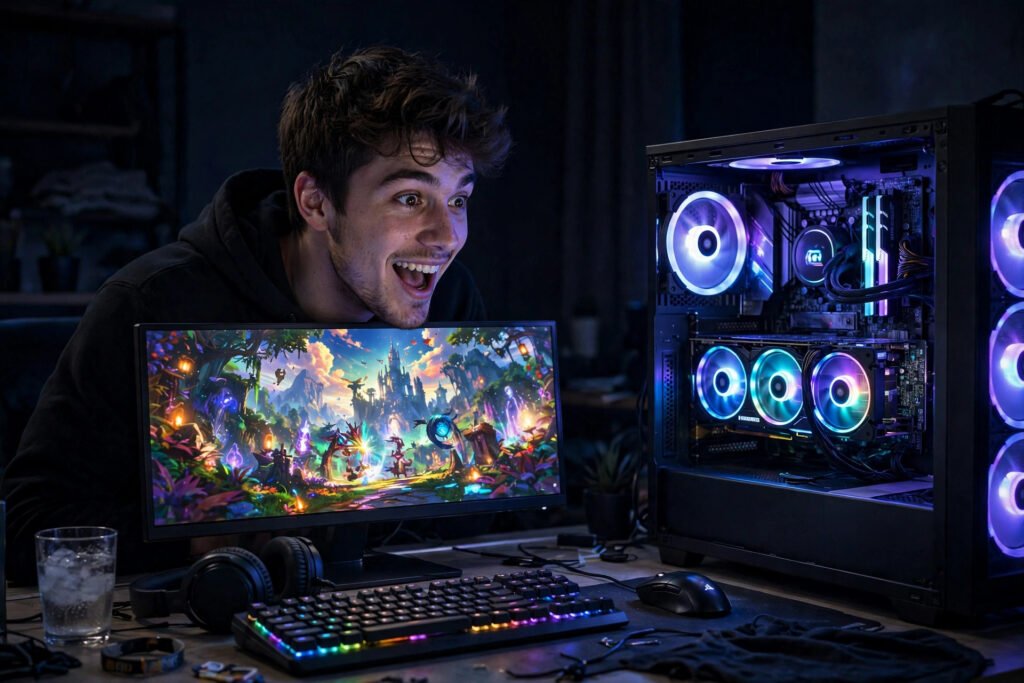
Last year I watched my nephew play a racing game on his laptop, and I could not stop staring — not at the race, but at the rain. Every drop splashed on the windscreen, the headlights glowed through the fog, and the whole city reflected in wet roads. Sixty frames every second, without a single stutter. My old laptop would have melted trying that. The secret is a second brain inside the computer that most people have never heard of: the GPU. It is the chip that draws your games, edits your videos, and — here is the twist — trains the AI tools everyone is talking about today.
📅 Want a study plan for this topic?
Get a free 7-day learning plan in your calendar — one small lesson every day.
What Is a GPU, Really?
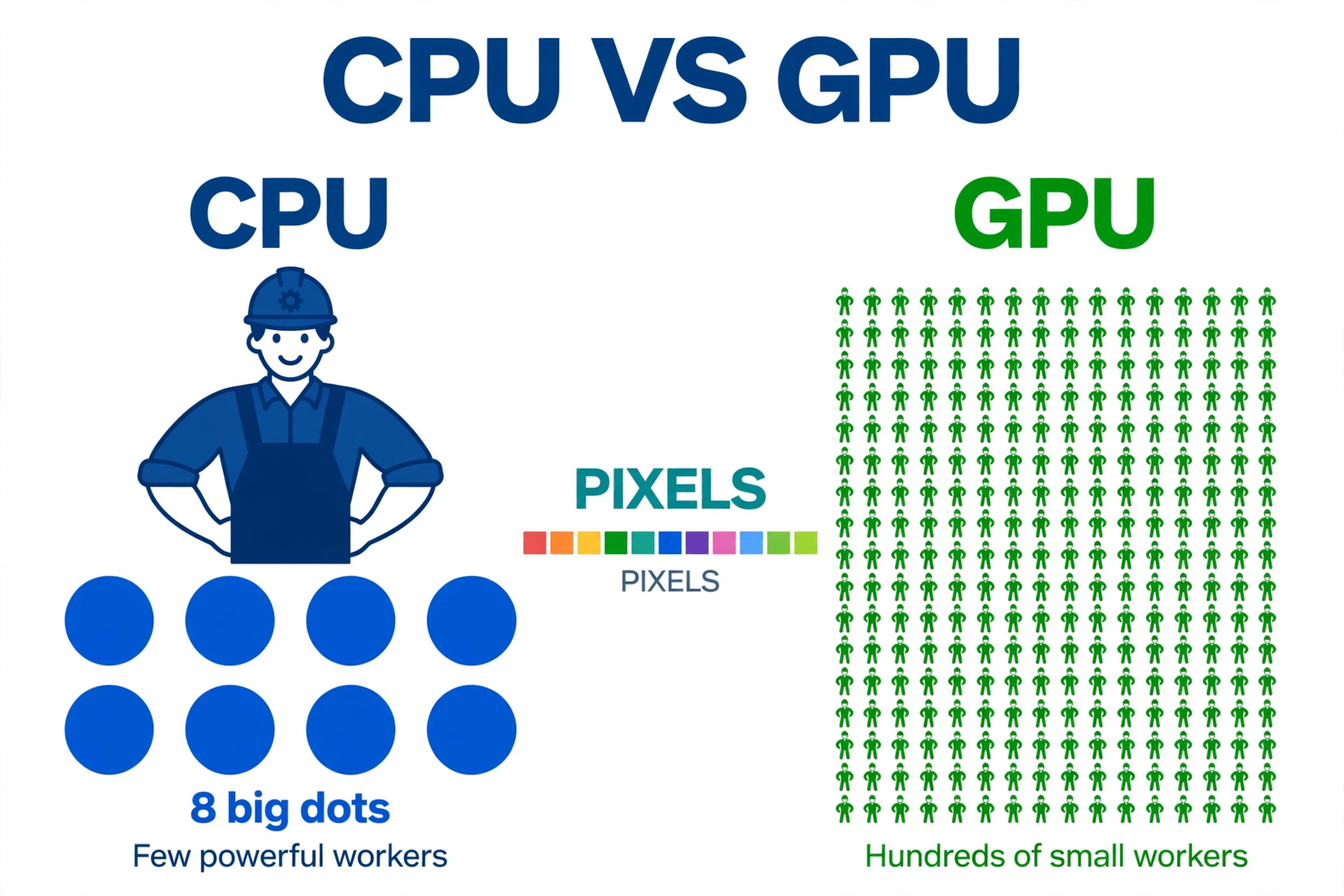
GPU stands for Graphics Processing Unit. Your computer already has a main brain, the CPU, which is brilliant at hard thinking — one tricky problem at a time, solved very fast. The GPU is built the opposite way: it is not as clever, but it has thousands of tiny workers that all do simple jobs at the same moment. Drawing a picture on your screen means colouring millions of tiny dots called pixels, and that is a job for thousands of simple workers, not one genius. That is why the GPU exists — it turns millions of small, boring calculations into a smooth picture, sixty times every second.
The Main Idea
Most beginners get stuck right here: they think the GPU is just "the gaming chip", so it has nothing to do with them. Honestly, that used to be true — but not anymore. The same trick that draws a game frame also trains AI models, because training an AI is also millions of small, simple calculations done at once. When I first understood this, it changed how I look at every laptop advert: the GPU is no longer a luxury for gamers, it is the engine behind video editing, 3D design, and the AI tools your friends use every day. Your phone has a small GPU too — it is why your camera can blur a background in real time.
In Simple Words
Here is the whole idea, in four steps:
- Your screen is made of millions of tiny dots called pixels, each needing a colour.
- A CPU colours them with a few very fast workers, one dot at a time.
- A GPU colours them with thousands of small workers, all at once.
- Thousands of simple jobs done together beat a few clever jobs done one by one — for pictures, anyway.
Let's Solve an Example: Painting 1,000 Pixels
Meet Ali. He has to colour a small picture of 1,000 pixels — a tiny rainbow. He tries two workers for the job. Watch what happens:
| Round | CPU: 8 fast workers | GPU: 1,000 small workers |
|---|---|---|
| 1 | 8 pixels coloured — 992 left | All 1,000 pixels coloured at once |
| 2 | 16 pixels coloured — 984 left | Done! Already moved to the next frame |
| 50 | 400 pixels coloured — still going | 50 whole frames finished by now |
| 125 | Finally done — 1,000 pixels | 125 frames finished in the same time |
Now scale that up. A normal full-HD screen has about 2 million pixels, and a game redraws them 60 times every second. That is 120 million pixels a second. No CPU on Earth can do that alone — but a GPU with 2,000 small workers eats it for breakfast. Notice the table carefully, because this is the part most people miss: the GPU workers are not smarter or faster than the CPU workers — each one is actually slower. The magic is the number of them. In my opinion, this is the most important idea in all of computing: the right tool is not always the strongest one, it is the one shaped like the job. A CPU is a genius professor; a GPU is an army of painters. You would not ask one professor to paint a stadium, and you would not ask an army of painters to solve one hard maths problem.
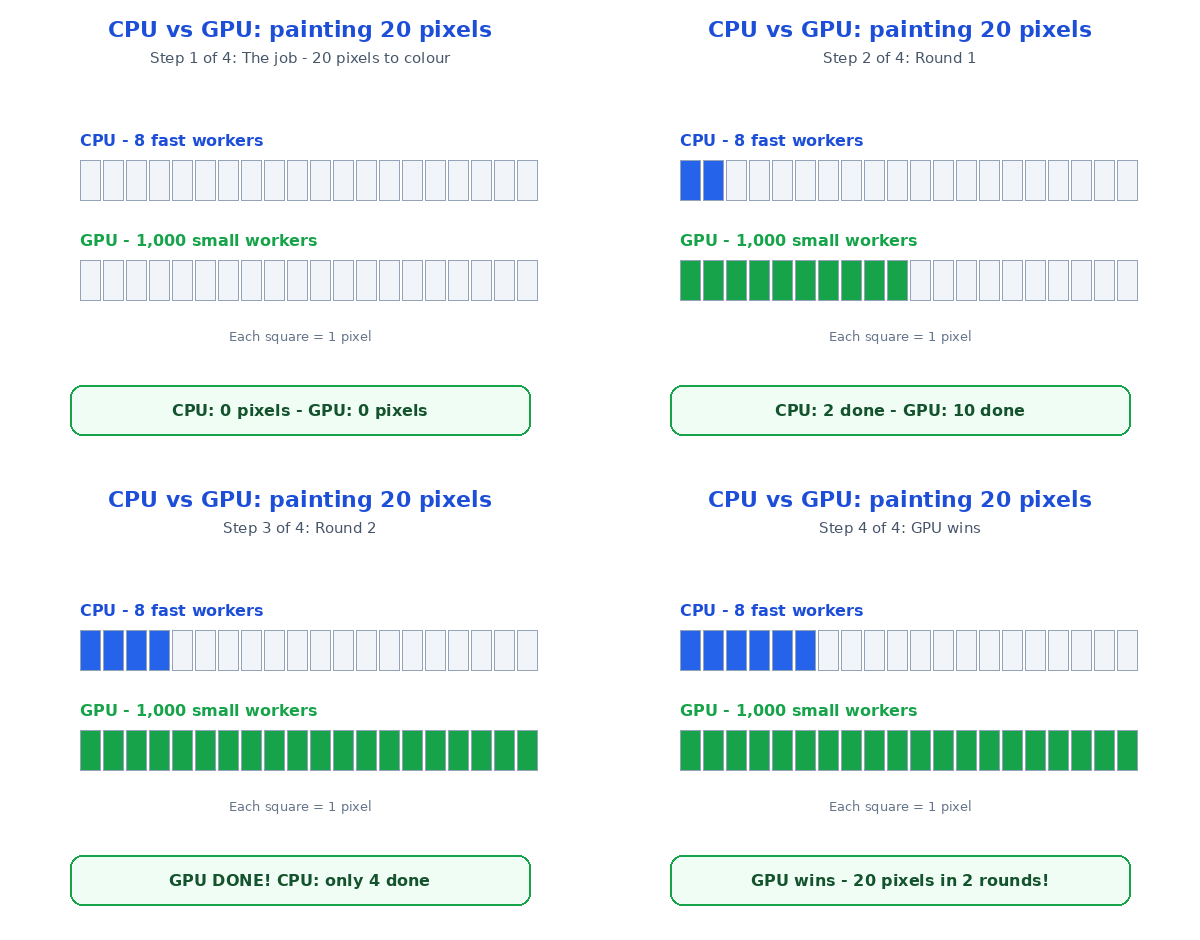
One practical tip from this example: this is exactly why video editors and AI apps ask about your GPU first. If you ever buy a laptop for video editing or AI work, the GPU matters more than the CPU — a mid-range CPU with a good GPU will beat a top CPU with a weak GPU, every single time. For plain office work and browsing, though, the built-in graphics in your CPU are honestly fine, and you do not need to spend a rupee more.
Why AI Runs on GPUs
Here is the twist that made GPUs famous outside gaming. Training an AI like a chatbot means adjusting millions of tiny numbers, over and over, until the answers get better. Each adjustment is a small, simple calculation — and there are millions of them, all independent. Sound familiar? It is the exact same shape as colouring pixels. That is why every AI lab in the world buys GPUs by the thousand, and why machine learning exploded only after GPUs became cheap and powerful. The gaming chip accidentally became the AI chip — and in my view, that accident changed the whole decade.
CPU vs GPU: A Quick Comparison
| CPU | GPU | |
|---|---|---|
| Workers | Few (4–16), very fast | Thousands, slower each |
| Best at | One hard job at a time | Millions of simple jobs at once |
| Examples | Opening apps, running your browser | Games, video editing, AI training |
| Memory | Works with your RAM | Has its own fast memory (VRAM) |
Test Your Understanding
Quiz: Ali's picture has 1,000 pixels. Why does the GPU finish first, even though each of its workers is slower than a CPU worker?
- The GPU has a faster internet connection
- The GPU colours all 1,000 pixels at the same time with 1,000 workers
- The GPU skips half the pixels to save time
- The GPU uses a bigger screen, so pixels are easier to see
Answer: B. The GPU wins by doing many simple jobs in parallel. One thousand small workers colouring one pixel each finish in a single round, while 8 CPU workers need 125 rounds — even though each CPU worker is individually faster.
Conclusion
A GPU is not a smarter brain — it is a bigger team. Thousands of small workers, all painting at once, turn millions of pixels into the smooth games, videos and AI tools you use every day. The CPU thinks hard; the GPU works wide. So do one thing today: the next time a game runs smoothly or your phone blurs a photo background in a blink, remember the army of tiny painters inside your device, colouring a million dots sixty times a second — and never asking for applause.
📅 Want a study plan for this topic?
Get a free 7-day learning plan in your calendar — one small lesson every day.
Leave a Reply