
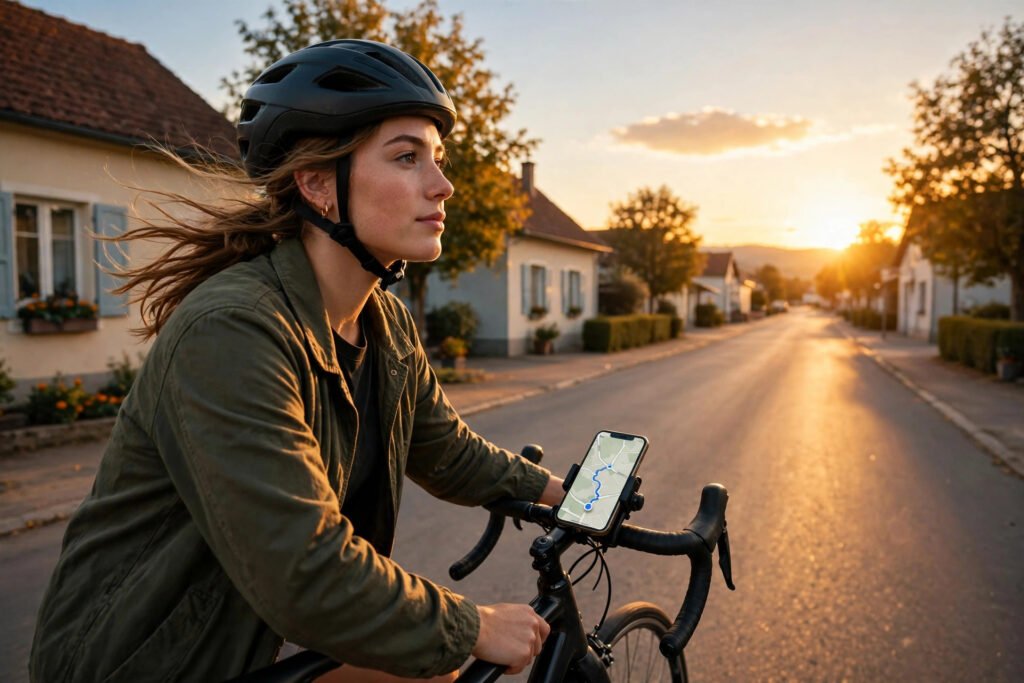
Last month I drove to a friend’s house in a part of Layyah I had never visited. No street signs I recognised, no one to ask — just my phone, calmly telling me “turn left in 200 metres” until I was parked outside his gate. How does this little rectangle know exactly where I am, on a planet 40,000 kilometres around? The answer is GPS, and it is one of the cleverest tricks in everyday technology. No magic, no guessing — just clocks, radio waves and a bit of school geometry.
📅 Want a study plan for this topic?
Get a free 7-day learning plan in your calendar — one small lesson every day.
What Is GPS, Really?
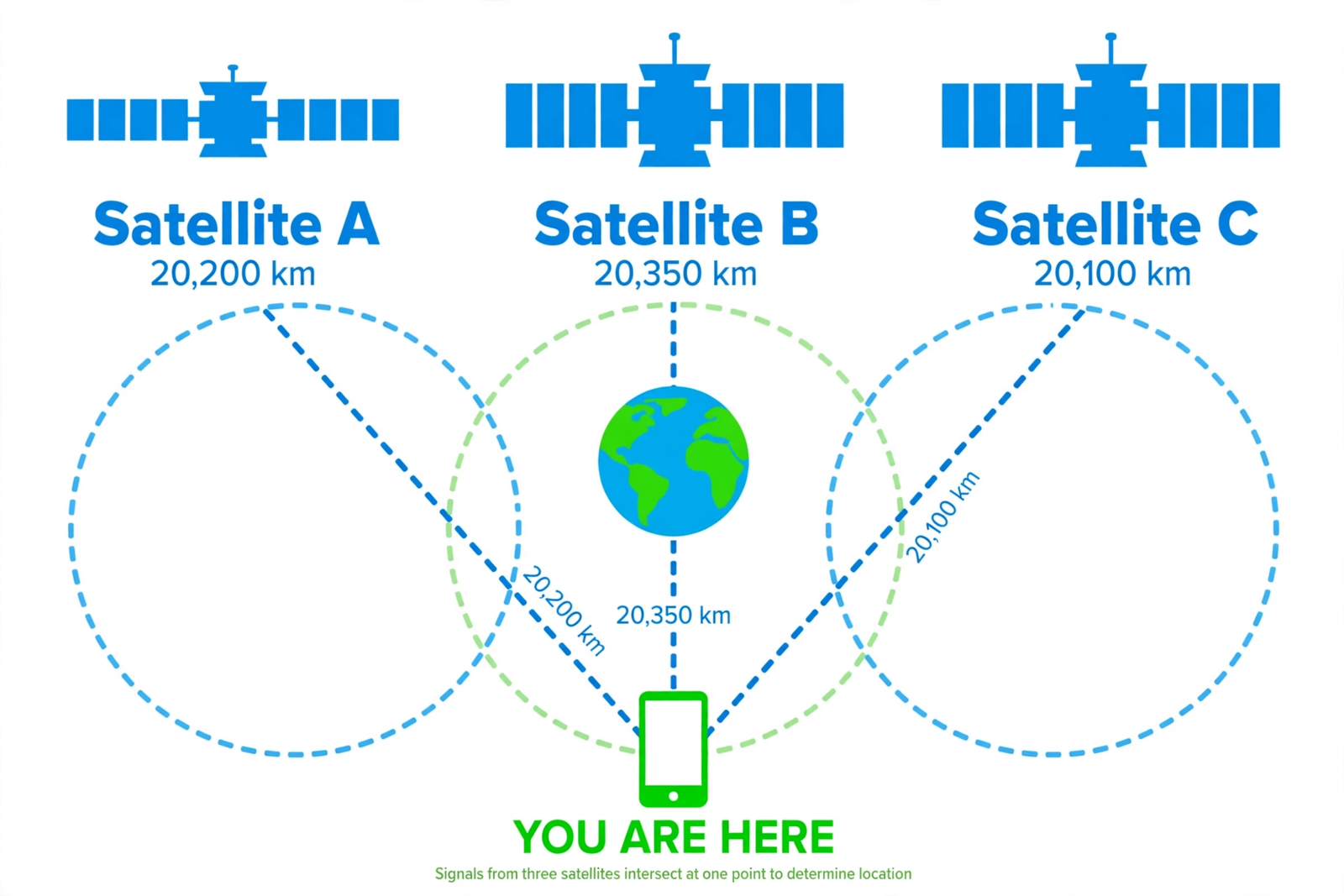
GPS stands for Global Positioning System. It is a network of about 30 satellites orbiting Earth, each one constantly shouting two things into space: "I am here" and "the time is exactly this." Your phone does not talk back to them at all — it just listens. By measuring how long each satellite's message took to arrive, your phone works out how far away that satellite is, and from three or four distances it pins down your exact spot on the map. The satellites never know you exist. Your phone does all the maths quietly, in a fraction of a second.
The Main Idea
Most beginners get stuck right here: they picture GPS as a camera in the sky watching them, or a tower that tracks their phone. Honestly, it is the opposite. The satellites are just very accurate clocks with radios attached, floating about 20,200 kilometres above your head. When I first understood this, it flipped the whole idea for me — your phone is not being found by anyone. Your phone finds itself, by listening to the sky and doing geometry. That is why GPS still works in the middle of a desert with no mobile signal at all.
In Simple Words
Here is the whole idea, in four steps:
- Each GPS satellite broadcasts its position and the exact time, over and over.
- Your phone receives the signals and measures how long each one took to arrive.
- Time delay times the speed of light gives the distance to each satellite.
- With three distances, your phone draws three spheres — where they meet is you.
Let's Solve an Example: Sara Finds Her Way Home
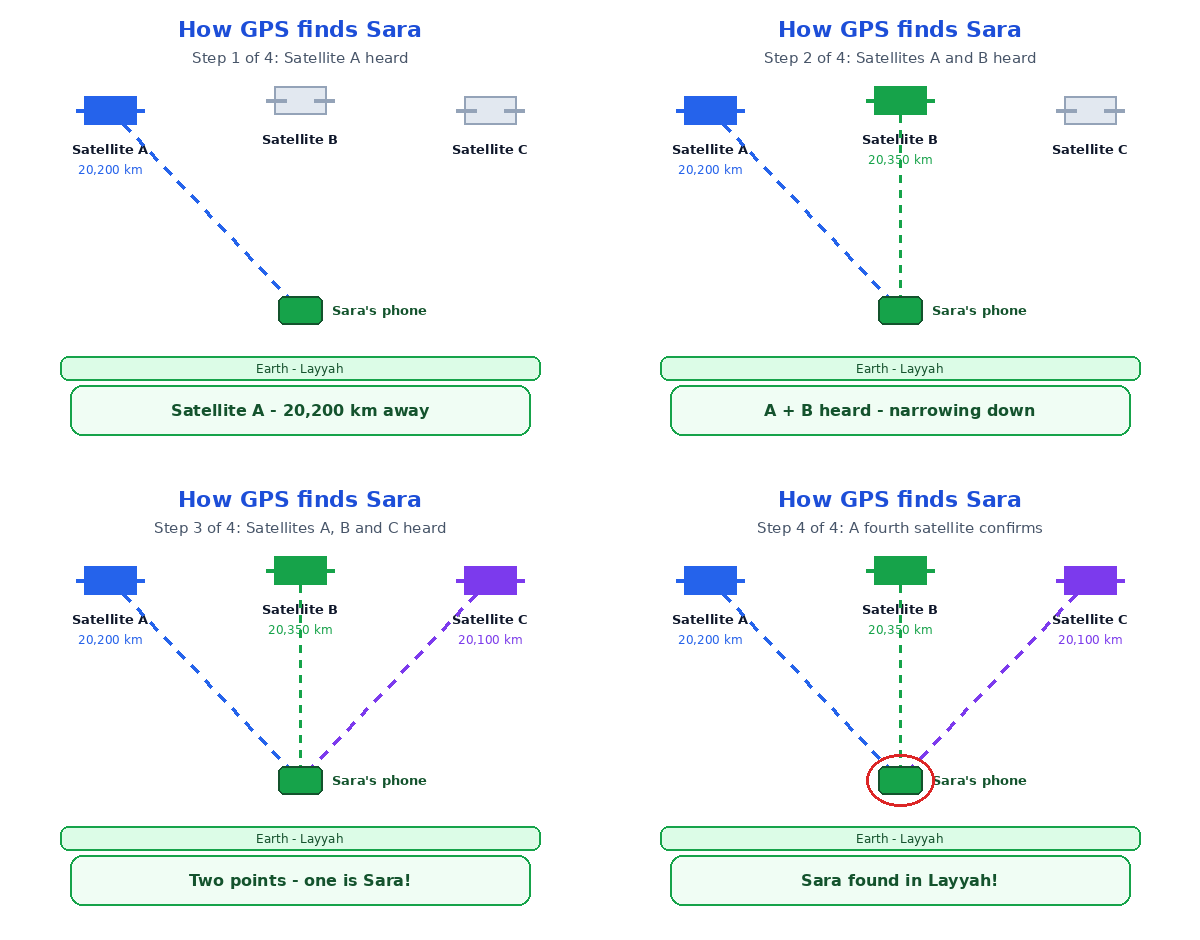
Meet Sara. She is cycling home in Layyah at sunset, and her phone has just locked on to three satellites. Watch her phone narrow her position down, step by step:
| Step | What her phone hears | Distance measured | What it knows now |
|---|---|---|---|
| 1 | Satellite A only | 20,200 km | She is somewhere on a giant sphere around A |
| 2 | Satellites A and B | 20,200 and 20,350 km | Two spheres cross in a circle — she is on that ring |
| 3 | Satellites A, B and C | 20,200, 20,350 and 20,100 km | Three spheres meet at two points — one is in space, one is Sara |
| 4 | A fourth satellite joins in | Confirms the fix | Her exact spot, plus it corrects her phone's clock |
Notice step 3 carefully, because this is the part most people miss. Three spheres always meet at two points, not one — but one of those points is floating uselessly in space, so your phone simply ignores it. The other point is you, standing on Earth. The fourth satellite is the perfectionist of the group: your phone's clock is not as accurate as the atomic clocks in space, so a fourth distance lets the phone fix its own timing error. In my opinion, this is the most beautiful part — your phone is solving a geometry puzzle with spheres the size of a planet, and it finishes before you have even glanced at the screen. That is also why your phone's processor matters: all that maths happens inside a chip smaller than your thumbnail.
One practical tip from this example: the first time you open Maps after a flight, your phone can take 30 seconds to find you. That is normal — it is downloading fresh satellite positions and doing the geometry from scratch. If you are ever in a hurry, step outside first; a clear view of the sky is the single biggest speed boost you can give it.
Why Your Location Sometimes Jumps Around
GPS is brilliant, but it is not perfect, and knowing when it struggles will save you a lot of confusion. Radio signals from space are weak — after travelling 20,200 kilometres they are fainter than a whisper — so anything between you and the sky gets in the way. Here are the usual suspects:
| Situation | What happens | Quick fix |
|---|---|---|
| Inside a tunnel or basement | Signals are blocked completely | Wait until you are outside again |
| Between tall buildings | Signals bounce off walls and arrive late | Your phone switches to Wi-Fi and mobile towers to help |
| Heavy rain or thick cloud | Accuracy drops a few metres | Nothing to do — it clears up on its own |
| First fix after a long flight | Phone needs fresh satellite data | Give it 30 seconds under open sky |
That middle row is worth remembering: when GPS alone is not enough, your phone quietly asks nearby Wi-Fi networks and mobile towers where they are, and combines everything. That is why your blue dot is still fairly accurate inside a shopping mall — it is not pure GPS any more, it is a team effort.
GPS vs Your IP Address: Two Ways to Find You
Beginners often mix GPS up with the location a website guesses from your internet connection. They are two completely different tricks. Your IP address can only tell a website roughly which city and internet provider you use — it never knows which street you are on. GPS, on the other hand, can place you within a few metres, because it measures real distances to real satellites. A website guessing your city from your IP is like a postman guessing your neighbourhood; GPS is the postman standing at your front door.
Test Your Understanding
Quiz: Sara's phone hears three GPS satellites. Why does it still want a fourth one?
- Three satellites are not enough to find any location at all
- The fourth satellite tells the phone Sara's name
- To correct the small error in the phone's own clock
- Because GPS only works with an even number of satellites
Answer: C. Three satellites are enough to narrow the location to two points, and one of those is in space, so the position is already known. The fourth satellite fixes the timing error in the phone's cheaper clock — without it, the position would drift by metres.
Conclusion
GPS is not a camera watching you from space — it is your phone listening to atomic clocks 20,200 kilometres away and solving a geometry puzzle with spheres. Three satellites narrow you down to one spot on Earth, a fourth one sharpens the answer, and a clear view of the sky is all it asks in return. Do one thing today: open your maps app, tap the blue dot, and think about the signals that travelled all that way just to tell you where you are standing. It is a small miracle you carry in your pocket every single day.
📅 Want a study plan for this topic?
Get a free 7-day learning plan in your calendar — one small lesson every day.
Leave a Reply